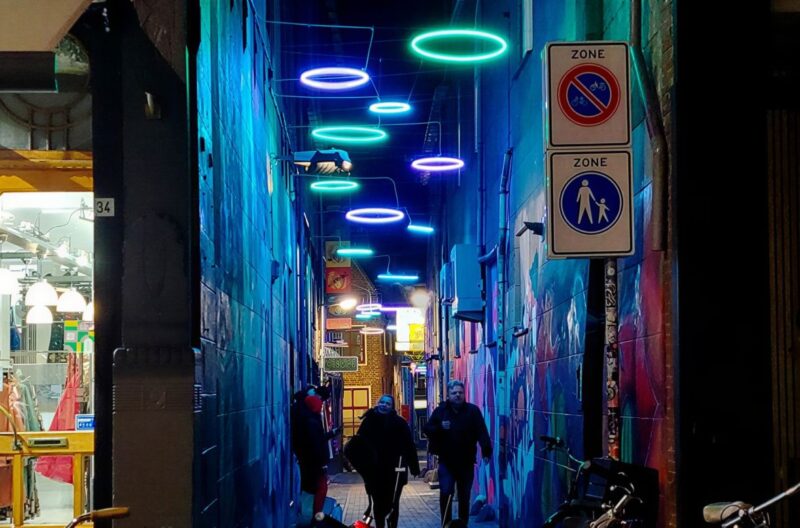
Groningen after dark: is nightlife facing a shift in the city?
House parties, pre-gaming, and people no longer going out at night, Groningen seems to be facing a cultural shift in what ‘nightlife’ represents to the people living in the city.
‘Honestly, clubbing itself, I don’t go that often. I used to go a lot more in the first year.’ Currently Adina, a fourth-year physiotherapy student at Hanze UAS, only goes out once or twice a month. One of the reasons for this is the surge of prices of alcohol in the bars and clubs. ‘If you go out with a group that really wants to party, it’s way more expensive. Especially when you start buying drinks’, she says.
‘At Sunny Beach we needed to raise the prices, I think students have noticed that’
Before going out Adina and her friends tend to do some pre-gaming together at one of their houses. They consume alcohol at home in order to spend less money and consume less alcohol in the city.
Former Sunny Beach club bartender Darija Sumenkova also noticed the rapidly rising prices of alcohol in the Groningen nightclubs. ‘At Sunny Beach we needed to raise the prices. I think students also have noticed that and maybe they preferred to do more drugs, or smoke weed, or drink at home’, says Darija, who thinks house parties are coming back.
Copas Club owner Miguel Restituyo also thinks house parties have become ‘the new normal’
Indeed they do, confirms Hanze student Adina. She and her friends have engaged in house parties more often. What started as a way for her to get to know new people in her first year living in Groningen, became an event she organizes with the people she is close with. ‘Throwing a house party is more convenient and we feel very relaxed about it, it has become the norm.’
Copas Club owner Miguel Restituyo also thinks house parties have become ‘the new normal’ in Groningen nightlife culture. ‘I think things changed since Covid. A lot of people came for their first year in 2020 when the pandemic was at one of its peaks. And, of course, they couldn’t go out. Then it was house parties or drinking at home with friends’, Miguel states.
Another factor is the increasing lack of safety people exprience in the city at night
Currently, Miguel sees that the ‘old fashioned clubbing way’ of going out for beer and shots no longer exists. ‘If they want to go out, they want to go to events, because these offer something different’, he explains earnestly.
The shift is also visible in Groningen’s nightlife landscape. In the past year, clubs Oost, Pepr, Klein Amsterdam and, most recently, Sunny Beach permanently had to shut their doors after years of parties and rounds of shots in the city.
Another factor that has begun to deter students from enjoying a night out in Groningen is the increasing lack of safety people feel they face in the city at night. Former Sunny bartender Darija: ‘At 1 or 2 AM, I would say it doesn’t feel safe. You see a group of 10-15 guys and they’re harassing you, you definitely don’t want to go out or drink that much. It’s better to stay at home.’
A previous study from Breuer & Intraval, conducted in 2025, shows that 63% of young people in Groningen do not feel safe going out at night. Breuer & Intraval researcher Erwin van der Lee finds that the experience of observing the streets of Groningen at night while sober made them understand why people no longer feel safe. ‘You see people puking, hanging around, shouting, fighting. All kinds of people come together and that can give some friction. In Groningen, there’s a feeling that everything is possible and that has something beautiful. You can do whatever you want here. But that doesn’t apply to those negative excesses, they really do need to change.’
In the same study, when asking both women and men, Erwin tells that 40% of the people questioned had been harassed in the span of a year, which they found to be a very big number. ‘It’s all different types, like touching, following around, catcalling. In recent years Groningen night life has become more and more unsafe, so in the years to come it may become even worse.’
Photo: Papengang in Groningen (photographer Ana Enescu)