‘Perhaps we need to accept that the traditional way of teaching is changing’
Students are staying away more often, AI is changing jobs and Hanze is undergoing a major overhaul. Hanze president Dick Pouwels mainly sees opportunities in this new reality.
Students are spending less time on campus, AI is rapidly changing both education and the labour market, and from September Hanze’s new organisational structure will have to prove itself in practice. For Executive Board president Dick Pouwels, all these developments come down to the same question: how should the university of applied sciences adapt to a world that is itself changing at breakneck speed?
To start with, the students. The Executive Board is receiving clear signals that students are physically present less often. At the same time, despite demographic decline, enrolment remains fairly stable, student satisfaction is rising and first-year dropout rates are lower than Hanze has been used to.
‘It’s a bit of a contradiction,’ says Pouwels, a week before the opening of the academic year. ‘The figures show that things are going quite well, but at the same time we hear that students are much less present. We’re going to have some serious discussions about that in the coming year. It may be that we need to change the ways in which we offer things.’
What do students still come to campus for?
Simply demanding that everyone dutifully returns to the classroom is not the answer, according to Pouwels. Covid taught students that digital education is also possible, and since then an even more far-reaching development has emerged: AI.
‘During Covid, students learnt that working digitally and attending classes online are also possible. At the same time, AI has given them an incredibly powerful assistant. If you’re not quite sure about something, you can simply ask. I think we mainly need to look for different ways of strengthening students’ connection with the university.’
That could also mean changing the traditional role of the classroom. ‘Perhaps we need to accept that there are now other methods and tools for transferring knowledge. That’s why we need to focus more on group work, working together on assignments and tackling real-world problems.’
That certainly does not mean students might as well stay at home, Pouwels warns. ‘Your time at a university of applied sciences is also about your personal development. And you don’t do that on your own. You need contact with other students and you need to work in groups, because that’s how life works too. It’s not just about developing professionally, building expertise and gaining knowledge, but also about: who am I as a person? How do I relate to other people? How do we achieve results together? That needs to be a very explicit part of your degree programme.’
‘AI can be an incredible joy, but I also see the downside’
Pouwels primarily sees the rise of AI as an opportunity. ‘I think it’s an incredibly powerful tool. You can gain insights more quickly, you have easier access to a much broader spectrum of information and you can get support with difficult calculations and analyses. I think it’s fantastic that all of that is becoming available.’
‘Perhaps it can even help us unleash more human creativity and collaboration, rather than having people do all sorts of things that technology might be able to do better and faster. Of course, I also see the downside when it comes to power, privacy and the kinds of addiction we also see with social media. People can completely lose themselves in these kinds of tools. That’s certainly an issue, but at the same time, it’s also an enormous opportunity.’
The problem for educational institutions is that developments are moving so quickly that rules can already be outdated by the time everyone has become accustomed to them. ‘AI is different from the digital developments we’ve known in the past. Back then, a new digital technology would enter the market, you would try it out and eventually understand how it worked. Then you could start optimising it and become more proficient at using it. AI is a learning mechanism. We need to get used to the fact that we now have a technology that will never stop developing.’
According to Pouwels, this also means Hanze needs to change the way it teaches students to use AI. ‘The question is no longer, “When do you use this tool?” but “How do you use it?”’
‘We were always very good at the first question. You’re allowed to use a calculator here, but not there. With AI, however, it’s about privacy and addiction, and about recognising where it is important to retain your own judgement rather than leaving everything to the system.’
Jobs will disappear
That discussion is not limited to education. AI is also changing the jobs students are being trained for. According to Pouwels, that could mean some entry-level jobs disappearing.
‘I can very well imagine students wondering where their job opportunities will be. Hanze needs to prepare students precisely for that new world. They need to properly understand how AI works as a technology and how to use it as a professional. That can actually give you an advantage over people who are already working and feel less pressure to really master AI.’
Degree programmes themselves will also have to change. Pouwels expects AI to play a much bigger role in ICT programmes. He does not even rule out the possibility of a dedicated AI degree programme in the future.
But he also foresees concrete consequences for fields such as communication. ‘Typical junior positions in that profession will disappear. Graduates will start their careers in a different way. Entire areas of work may disappear because companies will simply do it themselves. They may accept slightly less impressive quality in their communications because AI is faster and cheaper. Those kinds of trade-offs will be made differently than they were in the past. We need to prepare our students for that.’
Hanze is therefore considering whether AI should become a so-called ‘breakthrough project’, an area of development in which the institution fundamentally changes its approach and invests much more heavily.
‘If you look at developments in AI, both in our education and research and in our business operations, we’re going to have to make significant progress. There is a good foundation: many colleagues are actively involved and there are lots of great initiatives, more than we often realise. But at the same time, we need to put much more energy into this and move much faster.’
A new Hanze
Hanze itself is also entering a new phase. From 1 September, its new organisational structure will officially become operational. Over the past few months, managers have been appointed and assigned to their positions, systems have been adapted and staff have moved offices.
The process has not been without difficulties for everyone. ‘In a number of individual cases, it has genuinely been painful. We’ve seen that too. At the same time, as an organisation and together with the colleagues concerned, we’ve worked hard to find appropriate solutions. In most situations, we’ve succeeded. Where we haven’t, we’re still looking for solutions or at least making sure those situations receive sufficient attention.’
The real test begins now. ‘Essentially, everyone in the organisation is entering a new reality, with clusters and new managers. For some people, that will have greater consequences than for others. Above all, we hope that after some initial teething problems, it will also generate new energy.’
Pouwels certainly expects some teething problems. Processes are changing and staff will have to rediscover how the lines of communication work. Nevertheless, he is satisfied with the preparations. ‘The adjustments to our systems and the physical moves actually went very well this summer. That shows that our people have a good understanding of how our systems work. If something doesn’t go as expected, we can respond quickly.’
‘A kind of inner fire’
But the restructuring is about more than simply reorganising the institution. One of its key principles is that teams will be given more responsibility for organising their own work.
‘I do have a kind of inner fire when it comes to the idea that self-organisation and a knowledge institution belong together. We’re all professionals, so you should be able to expect a high degree of self-organisation and individual responsibility. As a team, you need to decide for yourselves: who does what? What best suits the talents of the different colleagues? How do we organise our work?’
According to Pouwels, that ownership must explicitly lie with the teams. ‘In almost every case at Hanze, you don’t have an individual assignment. It is up to the team to shape a degree programme, a field of research or part of the support activities. That means you also need to organise the work as a team and take control and ownership of that work. Ownership means: this is ours, we want to organise it properly, so let us organise it. It fits extremely well with a knowledge institution and a university of applied sciences. I think we’re ready to embed that kind of ownership much more deeply throughout the organisation.’
Staying connected
At the same time, greater self-organisation and new structures bring the risk that people may actually find it harder to connect with one another. That is why connection is at the heart of Pouwels’ speech at the opening of the new academic year.
‘We’ve obviously made some changes to the structure, but it’s important that people continue to be able to find one another and perhaps, in some areas, actively reconnect. That applies not only within Hanze, but also to Hanze’s relationships with all kinds of companies and fellow institutions in the region, nationally and internationally. Those connections are precisely what allow you to truly collaborate and make progress.’
He sees the same movement beyond the university. In the Northern Netherlands, provinces, public authorities, businesses and knowledge institutions are working together increasingly closely, while according to Pouwels, educational institutions in the north are also becoming less focused on competing with one another.
‘When you look at the world around us, it’s clear that collaboration has to be the answer. We cannot tackle the challenges we face on our own. We simply need one another. I think the urgency to collaborate has become much greater, simply because you can’t do it alone.’
Hanze enters this new phase in a healthy financial position. ‘We’re performing in line with our budget. We’re retaining some funds because we’ve spent less on developing our two-year plan than we expected. That gives us a buffer for 2027 and 2028, when we will still be dealing with the effects of demographic decline and the fall in student numbers in recent years.’ As a result, Hanze does not need to take the kind of drastic measures currently seen at some other institutions.
The main challenge in the coming year will be implementation: getting a new organisation up and running while both education and the world students are being prepared for continue to change.
‘Essentially, everyone in the organisation will soon be operating in a new context, with greater consequences for some than for others. Above all, we hope that after some initial adjustment, it will also generate new energy.’
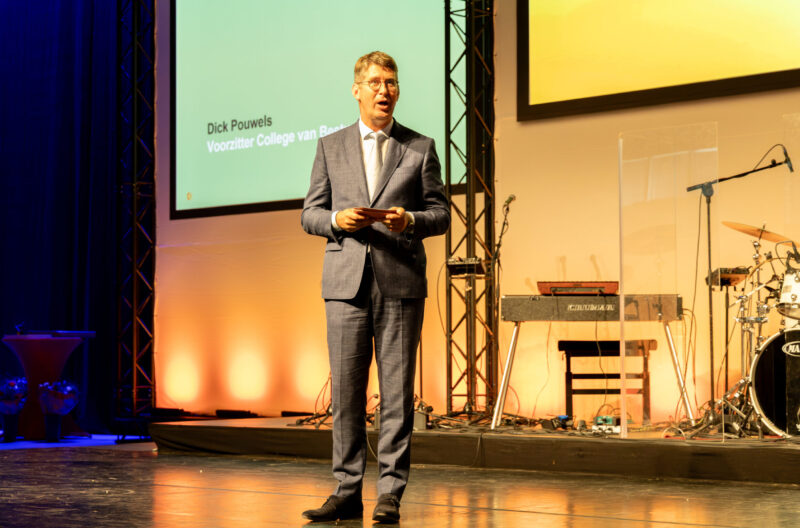
Photo: Dick Pouwels during the opening of the 2026–27 academic year (photographer: Jelmer Meijer)