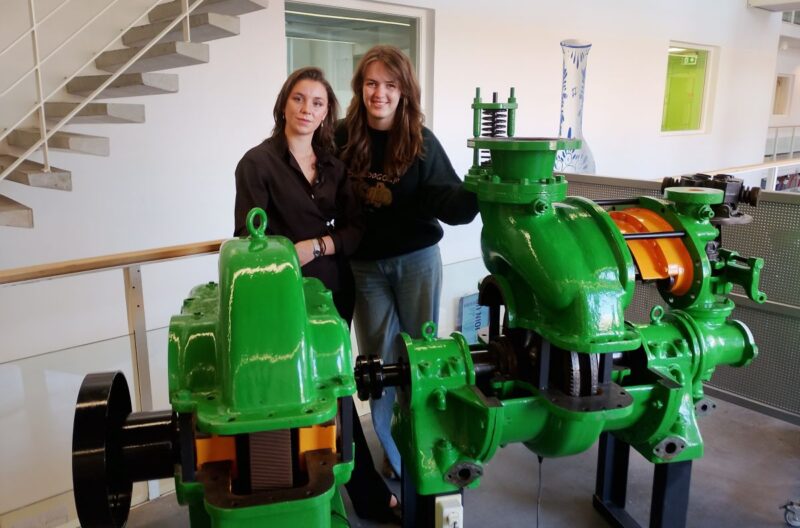
The only girl in class? No problem at all!
Marja and Danique are both studying technical programmes. These programmes are male-dominated, but that’s no problem, they say.
‘I’m sometimes the only woman in a project group, but that doesn’t bother me.’ Marja Heldeweg (19), a second-year Built Environment student, knew from an early age that she wanted to go into engineering. ‘Ever since I was a child, I’ve always been building things. When I discovered that Built Environment at Hanze includes civil engineering and spatial development, I enrolled straight away.’
Danique Eekelder (22), a third-year Mechanical Engineering student, can relate to that. ‘At secondary school, I was fascinated by physics. I wanted to know exactly how things worked.’ Mechanical Engineering seemed perfect for her. ‘It suits me. It’s a broad technical programme that opens up lots of possibilities.’
The recruitment campaigns for engineering programmes have not been an overwhelming success
Women are in the minority on technical degree programmes. According to the Dutch Department of Education, around one in four students on a technical higher professional education (hbo) or university (wo) programme is now a woman. In programmes such as Computer Science and Mechanical Engineering, that proportion is lower.
For years, universities of applied sciences and universities have been running campaigns and promoting role models to encourage girls to take an interest in technology. Although there has been some growth, these efforts have not been overwhelmingly successful. In higher professional education in particular, the percentage of women remains low. Danique: ‘I reckon in our Mechanical Engineering course, there are about ten per cent girls.’
Marja and Danique knew they would be in the minority. ‘It’s a male-dominated field, you have to take that into account,’ says Marja. Danique: ‘At an information webinar I took part in, there were about thirty people. I think I saw four women.’
At first, Danique felt that the other students had a head start
It didn’t hold them back. ‘Yes, I was one of the few, but that never bothered me,’ says Marja. Danique wasn’t particularly worried beforehand either. ‘Everyone was actually very positive. My dad works in building services engineering and all his colleagues said: How cool that your daughter’s going to study mechanical engineering! In our day, there weren’t any women at all.’
Marja simply remains true to herself. ‘I was once chair of a project group. During a presentation, two members were absent. Well, what do you do in that situation? I began by saying: We’re missing some information because two group members are absent.’ The lecturers appreciated that. ‘They thought it was impressive that I was so clear.’
At the start of het studies, Danique felt that the other students had a head start. ‘They all had technical experience. They came from vocational colleges, where they’d already studied engineering. Their hobbies were often related to technology too. I kept thinking I was lagging behind,’ she says. During a review, it turned out that wasn’t the case. ‘In fact, my class mates said: You contribute just as much as we do. And you’re even quicker at maths.’
‘I think women have a different way of communicating and leading’
But stereotypes and prejudices are hard to avoid, as Danique discovered. ‘I didn’t really notice it in the others, but more in myself. On the one hand, I didn’t want to reinforce the stereotype that girls don’t belong in engineering. But on the other hand, I thought most of the boys had more experience and knew more than I did.’ Partly because of this, Danique was less inclined to ask questions in her first year. ‘I was a bit worried that my questions might be stupid. In the end, I got over that. Of course, there’s no such thing as a stupid question. If you don’t ask questions, you can’t learn.’
According to Marja, people at Built Environment treat you as an equal. ‘You’re simply on an equal footing with everyone.’ She does, however, notice that women sometimes communicate differently. ‘I think women have a different way of communicating and leading. During a conversation, we sometimes listen more closely to what’s being implied. That enables us to convey the information more clearly.’
They really like the atmosphere: ‘Nice and down-to-earth, it’s straight from the shoulder’
Danique: ‘Women tend to delve a bit deeper into things or talk more about feelings. With men, it’s often just a bit of daft banter and talking about technical stuff.’ Make no mistake, that’s an atmosphere they like. ‘Nice and down-to-earth. It’s straight from the shoulder.’
Danique saw herself changing. ‘I’ve started paying a lot less attention to my make-up, hair and clothes. I’m on a programme with loads of lads who just grab the top shirt off the top shelf of the wardrobe. Why should I spend an hour and a half on it?’ She’s found a good balance. ‘At school I’m surrounded by men, but outside of that I spend more time with women. When I’m with my girlfriends again, I think: it’s actually quite nice to have a chat in a different way.’
Of course, they hope that more women will choose to study engineering. ‘It’s great when there are lots of different perspectives,’ says Marja. Danique tries to encourage prospective female students during open days. ‘If I see a girl there, I always go and have a chat with her. Go on, it’s fun. Please, come and join us.’
Photo: Marja Heldeweg (l) en Danique Eekelder (r)